
As an Olympian Life Coach, I am highly respectful of the vast knowledge base that encompasses all conceivable and inconceivable possibilities. It’s easy to become so accustomed to your own knowledge that you lock yourself tightly into a box that contains only what you know. You’ve studied, you’ve learned, you’ve accumulated experiences that have proven themselves to you, and from this collection of data, you draw your conclusions about what works and what doesn’t. And for you, those conclusions are valid. They’ve brought you to this place in your life, and they’ve given you results. But here’s where the trap lies: believing that because something worked for you, it must also be the solution for everyone else. That’s not how it works.
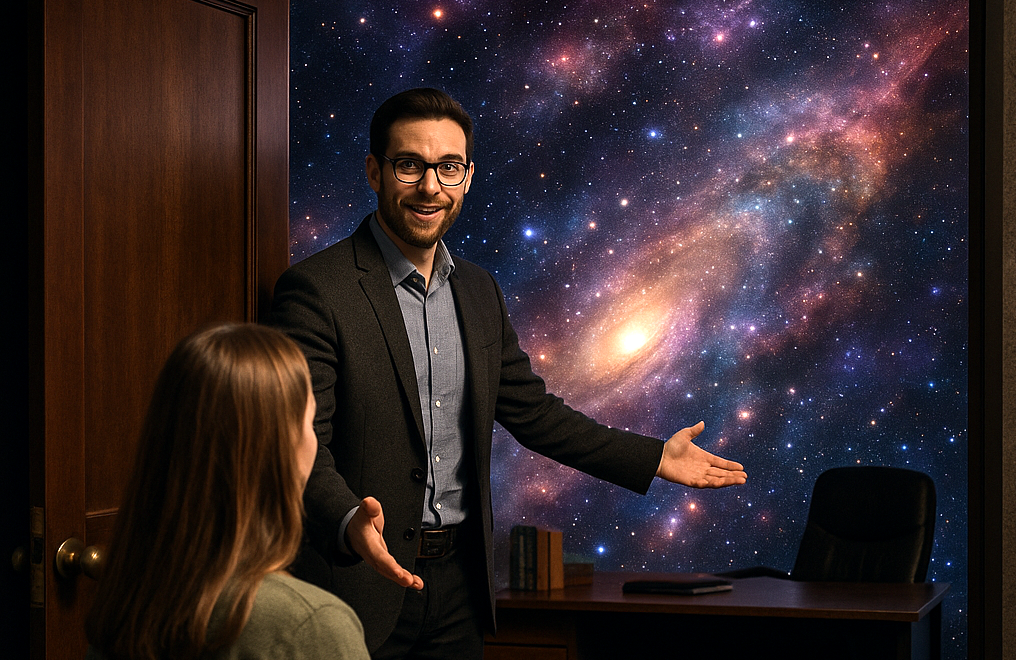
When you’re coaching, or even when you’re simply listening to a friend or colleague, you’re entering the sacred space of another person’s life. And every life is unique. Each individual is their own universe of experiences, beliefs, struggles, and victories. What worked for you may or may not be relevant for them.
Think of Your Client as an Alien
One of the best practices I’ve discovered is to treat every client as if they were an alien from another world.
If you met an actual alien, you wouldn’t rush in with a pre-packaged set of answers. You wouldn’t assume you understood their culture, their challenges, or the way they interpret the universe. You’d be curious. You’d lean in with awe and respect. You’d want to understand what makes them tick, how their world shaped them, and what resources they already carry within.
Why not bring that same sense of wonder to the people sitting in front of you?
When you do, you’ll stop forcing people into your box of knowledge. Instead, you’ll open the door to learning from them while helping them navigate their own unique path forward.
The Limited Menu vs. Unlimited Space
Many coaches and consultants unknowingly serve from a “limited menu.” They offer a handful of solutions, tools, and techniques—usually the ones they know best—and try to fit every client into those models.
An Olympian Life Coach operates differently.
Instead of inviting the client into our space, we first invite the client to sit. Then, the space that opens up becomes their sacred space, not ours. We step into their world and work with them from that perspective.
This approach is far more reverent, far more effective, and far more transformational.
When you enter their space with curiosity and humility, you don’t just see the problem. You see the person. You don’t just offer solutions—you co-create possibilities.
Don’t Force a Paradigm Shift Where It Isn’t Needed
Yes, sometimes a complete paradigm shift is necessary. Some clients are stuck in destructive cycles that demand a new perspective in order for healing and growth to take place.
But often, clients already have positive momentum in certain areas of their lives. If that’s the case, the worst thing you can do is knock them off-track by demanding they abandon everything they know in order to fit into your paradigm.
Honor their progress. Build on what’s already working. Help them strengthen their own foundation before suggesting a new one.
Curiosity Over Prescription
The moment you assert, “This is this” or “That is that,” you’ve stopped exploring. You’ve limited the infinite possibilities down to a single conclusion.
But when you remain curious—when you stay open to the truth that there are unlimited possibilities you might not yet be aware of—you not only serve your client better, you also expand your own consciousness.
As coaches, we’re not just teachers—we’re students. Every client, every session, every conversation is an opportunity to learn, grow, and deepen our respect for the magnificent variety of human experience.
The Olympian Difference
Olympian Life Coaches are comfortable working outside the box. We don’t force clients to adopt our worldview; we enter theirs. We don’t prescribe from a set menu; we co-create new recipes. We don’t flatten the universe of possibilities into a single “proven path”; we honor the infinite potential that exists in every human soul.
That’s what makes the work sacred. That’s what makes the work effective.
And that’s what makes the work Olympian.